


We need to talk about meditation. Not the app-guided, ten-minute-before-bed kind, but the real, raw, undiluted version—the kind where your mind has absolutely nowhere else to go. For anyone whose thoughts race, who finds stillness elusive, or who thinks they just “can’t meditate,” there exists a brutal, beautiful shortcut. The cold plunge doesn’t complement meditation. In many ways, it is meditation, distilled to its most essential, non-negotiable form. It’s a forced, immediate, and profound confrontation with the present moment that rewires your relationship to your own mind and body in a way sitting in silence often can’t.
The Ultimate Anchor: Sensation as a Mandatory Focus
The core challenge of traditional meditation is maintaining focus, often using the breath as an anchor. The mind wanders, you gently bring it back. In an ice bath, the anchor isn’t gentle—it’s a siren. The intense, all-consuming shock of the cold becomes the only possible object of focus.
Your mind cannot ruminate on a work email or a future worry. It is hijacked by the sheer volume of interoceptive data—the screaming signals from your skin, your core, your lungs. This is forced mindfulness. The practice of observing sensation without immediate reaction is no longer an abstract concept; it is a survival skill. You are, by physiological necessity, plunged into the “now.” This intense sensory anchoring creates a neural pathway for presence that is more direct and potent than any guided visualization. It’s meditation without the option to cheat.
The Breath as a Lifeline: Primal Breathwork
In a room, focusing on your breath is a choice. In cold water, controlling your breath is a imperative. The initial gasp—the cold shock response—is pure autonomic panic. The act of overriding this with deliberate, controlled breaths is the essence of pranayama (yogic breath control), but under the most intense duress.
This is where the cold plunge becomes an active meditation on mastery. Techniques like the Wim Hof Method, with its emphasis on deep, rhythmic breathing followed by breath retention, are not just tricks to endure the cold. They are structured practices of autonomic nervous system regulation. The breath becomes the sole lever you have to pull to steer your body from a state of sympathetic “fight-or-flight” panic toward a state of controlled, parasympathetic-dominant calm. Each controlled exhale is a direct signal to the vagus nerve, a deliberate act of self-soothing amidst chaos. This is not passive observation; it is active, high-stakes engagement with your own physiology. The link between breath control, cold exposure, and stress resilience is a core focus of related research into these methods. (Relevant study exploring the mechanism: Voluntary activation of the sympathetic nervous system and attenuation of the innate immune response in humans)
Dissociation vs. Observation: A High-Stakes Mental Drill
A common, often unconscious, reaction to severe discomfort is to dissociate—to mentally “leave” your body. The ice bath presents a critical crossroad: you can either dissociate (white-knuckle through it, wishing you were elsewhere) or you can practice non-judgmental observation.
This is the advanced curriculum. It involves turning toward the sensation. Noticing the specific quality of the cold—is it a sharp burn, a deep ache, a numbing wave?—without attaching a narrative of suffering to it. You separate the raw sensory data from the emotional story of “this is terrible, I need to get out.”
This is a direct training in equanimity, a cornerstone of Buddhist meditation. By practicing this in the container of a 3-minute cold plunge, you build the neural muscle to apply it to psychological discomfort—anxiety, anger, frustration. You learn that a sensation, no matter how intense, is not you. It is a temporary experience you are having. The ice bath provides the undeniable, physical proof of this concept.
The After-Drop: Integration and the Quiet Mind
The profound meditative state often peaks after you exit. The surge of endorphins and dopamine, coupled with the massive effort of nervous system regulation, often leaves the mind in a state of unusual quiet. The mental chatter that was forcibly silenced by the cold often does not return at full volume.
This post-immersion period is a state of natural, effortless awareness. It’s the “gap” between thoughts that mediators spend years trying to access. The body is humming, alive, and the mind, having been so intensely focused, is clean and clear. This is the ideal state for a traditional seated meditation, as the mind is already primed for stillness. The cold plunge acts as the ultimate preparatory ritual, burning off the restless energy that makes sitting still so difficult.
Building Resilience Through Voluntary Discomfort
At its heart, much of meditation is about changing your relationship to discomfort—the discomfort of boredom, of itchy sensations, of difficult emotions. The cold plunge accelerates this training by orders of magnitude.
By voluntarily choosing a controlled, acute discomfort, you are performing a powerful psychological operation. You are telling your brain that you can face extreme sensations and not be harmed. This builds distress tolerance. The “monkey mind” that throws a tantrum at the slightest inconvenience meets its match in the undeniable, survivable reality of the cold. Each session is a lesson in impermanence—the intense discomfort peaks, changes, and subsides, teaching you on a visceral level that all states are temporary.
A Practical Synergy
For the professional seeking to merge these practices, the approach is intentional.
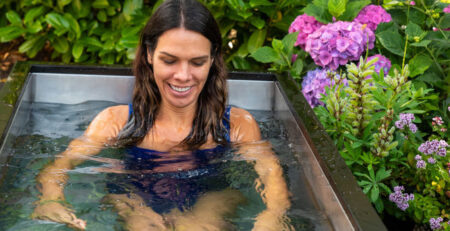
- The Plunge as Meditation: Approach the immersion itself as your seated practice. Your anchor is the cold. Your object of observation is the symphony of physical and mental responses. Your breath is the tool of regulation.
- Sequential Practice: Use a 2-3 minute cold plunge as a direct primer for a 10-20 minute seated meditation. The physiological calm and mental clarity post-plunge create a unique gateway to deeper states.
- Mindful Protocol: Even the preparation—filling the tub, testing the temperature—can be part of the ritual, a moving meditation that builds intention.
The cold plunge, therefore, demystifies meditation. It removes the abstraction and provides a tangible, physical crucible in which the core skills—focus, breath control, non-judgmental observation, and equanimity—are not just learned but forged. It is meditation for the restless, the skeptical, and the action-oriented. In the silent, screaming cold, you don’t think about being present. You have no other choice.

Leave a Reply